
Volleyball Mania is reader-supported. When you buy through links on this page, we may earn a commission at no extra cost to you. As an Amazon Associate I earn from qualifying purchases.
The best volleyball training equipment lets you practice the skill you’re weakest at without a full team. This guide picks gear by skill: setting, passing, hitting, solo practice and strength, from a setting net to a set of resistance bands.
How this guide was made: Volleyball Mania hasn’t tested this equipment. The picks come from the makers’ specifications and retailer listings. We link to every product so you can check the details.
Quick picks
| Pick | Trains | Good for |
|---|---|---|
| Bownet Volleyball Setting Net | Setting and serving accuracy | Setters, teams, home practice |
| Tandem Sport Pass Rite | Passing platform | Beginners and young players |
| Tandem Sport Spike Pal | Arm swing and hitting | Solo hitting practice |
| Tandem Sport Collapsible Spike Trainer | Arm swing, contact and footwork | Teams and coaches |
| Solo trainer belt | Serving, setting and hitting alone | Practicing at home without a partner |
| Fit Simplify loop bands | Hip, leg and shoulder strength | Strength and injury prevention |
Setting
1. Bownet Volleyball Setting Net
Best for: setters, coaches and players who want instant accuracy feedback.
A target basket, about 3 by 2.5 feet, on an adjustable frame that catches sets and serves, so you see right away whether you hit your spot. Bownet says it sets up in about a minute without tools, weighs 21.5 pounds, and comes with a carrying bag. Its non-marking feet work indoors and outside.
- Good to know: Bownet’s page lists two different maximum heights, so check the listing if you need a high target.
Passing
2. Tandem Sport Pass Rite
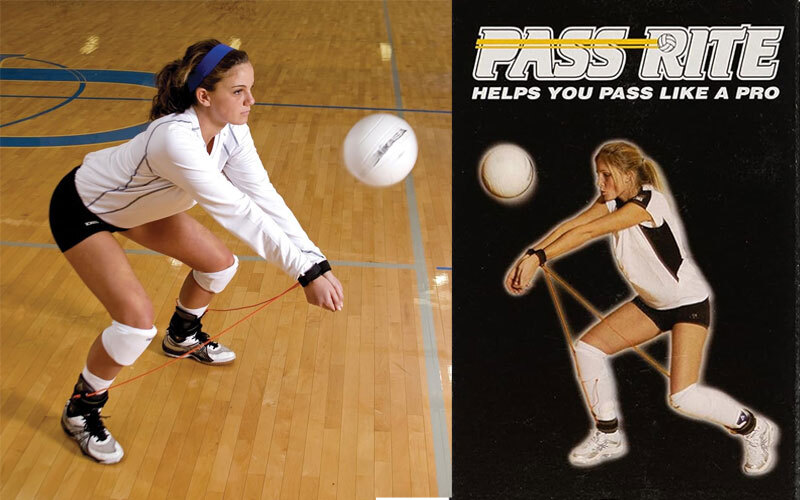
Best for: beginners and young players who swing their arms when they pass.
An elastic band connects your wrists to your ankles and stops your arms rising too high, which teaches you to pass with your legs and a steady platform instead of swinging. Small wrist cuffs keep it out of the ball’s way, and it adjusts for different heights.
Hitting
3. Tandem Sport Spike Pal
Best for: players who want to work on their hitting form alone.
A ball-like target on a 15.5-inch elastic cord that clips to a basketball hoop or tall pole with a carabiner. You hit it, it swings back, and you can repeat your arm swing as often as you like.
4. Tandem Sport Collapsible Spike Trainer
Best for: teams and coaches teaching arm swing and approach.
An aluminum pole that holds a volleyball in place, so players can practice their approach, arm swing and contact without a moving ball. It extends to about 64 inches and collapses to about 45 for transport.
Solo practice
5. Solo trainer belt
Best for: practicing serves, sets and hits at home without chasing the ball.
These trainers hold a ball in a pouch on an elastic cord attached to a belt around your waist. The ball comes back to you after each contact, so you can get far more touches in a short session. Many brands make them; check cord length and reviews before buying.
Want something bigger? A rebounder net returns passes, sets and hits from a full 7 x 4 ft surface, with angle settings for each skill. See the best volleyball rebounders.
Strength and injury prevention
Resistance bands are cheap and portable, and they’re useful for the hip, leg and shoulder strength volleyball players need. Loop bands are best for legs and hips; long flat bands are best for shoulders.
6. Fit Simplify resistance loop bands
Best for: leg and hip exercises like band walks and glute bridges.
A set of loop bands in several resistance levels, with an instruction guide. Start with a light band and move up as exercises get easy.
7. TheraBand resistance bands
Best for: shoulder exercises for hitters and servers.
Long, flat, latex-free bands that physical therapists commonly use. They’re good for the shoulder rotation exercises that protect a hitting arm.
8. SKLZ Mini Bands
Best for: a small, cheap set for warm-ups.
Small loop bands for activating hips and glutes before practice. They fit easily in a volleyball bag.
A simple band routine for volleyball
| Exercise | Band | Why it helps |
|---|---|---|
| Lateral band walks | Loop band around the ankles or above the knees | Hip strength for side-to-side movement |
| Glute bridges | Loop band above the knees | Stronger jumps and safer landings |
| Shoulder external rotation | Flat band anchored at elbow height | Protects the hitting shoulder |
| Pull-aparts | Flat band held at chest height | Upper-back strength for arm swing |
Do two or three sets of 10–15 slow reps, two or three times a week. If you’re recovering from an injury, ask a physical therapist which exercises suit you.