
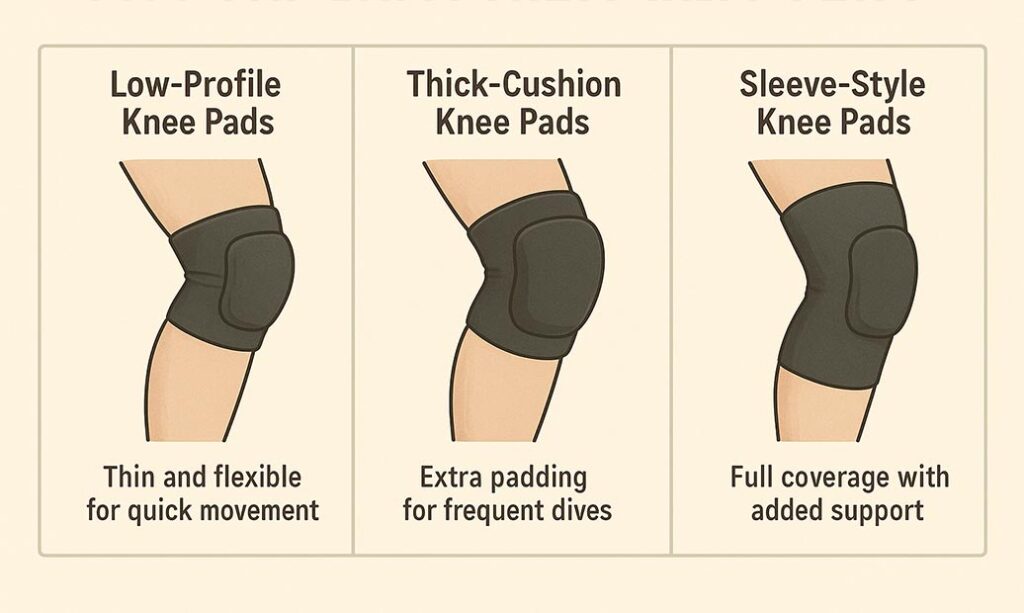
Knee pads only protect you if they sit in the right place and stay there when you hit the floor. This guide covers how to put volleyball knee pads on, how they should fit, how to measure for them, and how to keep them clean.
Why volleyball players wear knee pads
Volleyball is played on hard floors, and defensive players go to the ground constantly: diving for digs, sliding into passes, dropping to one knee to receive a serve. Knee pads cushion the kneecap on those landings and prevent the bruises and floor burns that come from bare knees on a gym floor.
They also change how you play. Players who aren’t worried about their knees commit to balls they’d otherwise let drop. That’s why liberos and defensive specialists wear the thickest pads, while middles who rarely dive often choose thinner ones.
How to put on volleyball knee pads
- Check which way is up. Most pads have a thicker padded area for the kneecap, and many have a label or logo that sits at the top.
- Slide your foot through the sleeve and pull it up your shin.
- Center the padding over your kneecap. The pad should cover the whole kneecap, with the sleeve gripping your thigh above and your calf below.
- Bend into a ready position, then lunge and crouch. The pad should stay centered without bunching behind the knee.
- Adjust before you play, not during. If you’re pulling them up between rallies, they don’t fit.
How should volleyball knee pads fit?
Snug, not tight. A good fit stays put when you dive but doesn’t pinch behind the knee or leave deep marks after practice.
| Sign | What it means | Fix |
|---|---|---|
| Slides down when you dive or run | Too big | Go down a size |
| You keep pulling them up between rallies | Too big, or a worn-out sleeve | Go down a size, or replace them |
| Pinches or bunches behind the knee | Too tight, or too long | Go up a size, or try a low-profile pad |
| Leaves deep red marks or tingling | Too tight | Go up a size |
| Padding sits above or below the kneecap | Wrong size or worn too high or low | Re-center it; check the size chart |
How to measure for volleyball knee pads
- Use a soft tape measure and measure around your leg at the point the brand’s size chart names.
- Most brands measure around the middle of the knee. Some say where exactly: Under Armour, for example, measures the widest part of the knee, over the kneecap, with the leg bent to about 45 degrees.
- Compare with that brand’s own chart. A medium in one brand can be a small in another.
- Between two sizes? Players who dive a lot usually choose the smaller size so the pad stays put.
Why do some players wear knee pads low?
You’ll see players with pads pushed down over the top of the shin. A common reason is that on a dive or slide, the area just below the kneecap often takes the impact. Some players also push them down between rallies or in warm-ups for comfort. Wear them where they protect the spot that hits the floor when you play.
Knee pads for kids
Kids’ pads need the same snug fit, and it matters more, because a loose pad on a young player slides off in the first dive. Use the brand’s youth size chart, check the fit at the start of every season as they grow, and avoid buying a size up to grow into. Our youth vs. adult knee pads guide covers the differences.
How to clean volleyball knee pads
- Machine washing: put them in a mesh laundry bag and use a cold, gentle cycle with a mild detergent. The bag stops the sleeve stretching.
- Hand washing: soak them in cold water with a little mild detergent, squeeze them through, and rinse well. A splash of white vinegar in the soak helps with smell.
- Drying: air-dry them flat or hanging. Skip the dryer; heat can shrink the fabric and break down the foam and elastic.
- Between washes: take them out of your bag after every practice so they can dry. Sweaty pads left in a closed bag are what start the smell.
- Always check the care label first, because some pads aren’t machine-washable.
When to replace your knee pads
Replace them when the padding feels flat over the kneecap, the elastic stops holding them up, or the fabric tears. Players who train several times a week often need a new pair every season.
Ready for a new pair? See our guide to the best volleyball knee pads.