
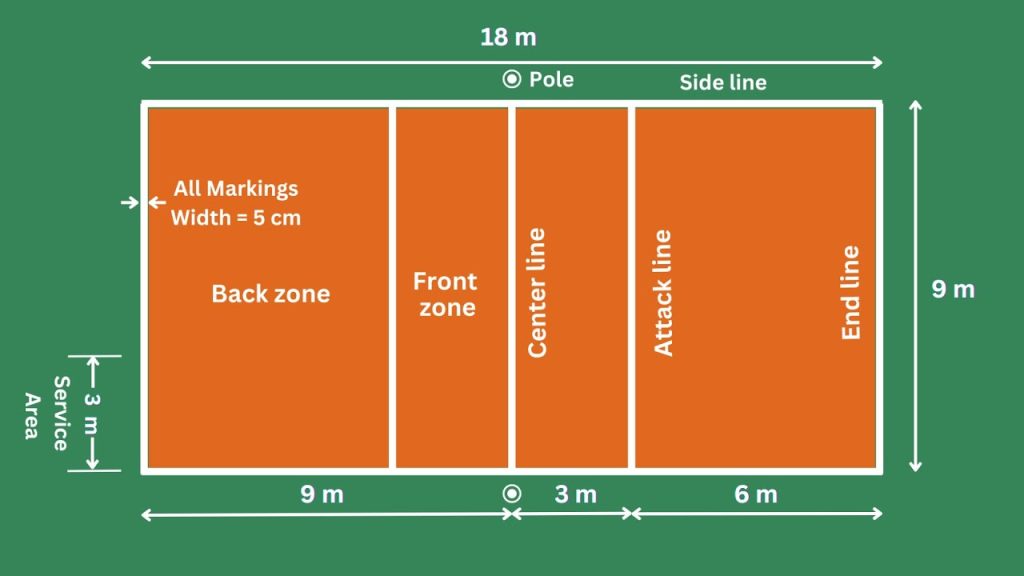
An indoor volleyball court is 18 m long and 9 m wide (59 ft × 29 ft 6 in). The centre line splits it into two 9 × 9 m halves, and an attack line on each side sits 3 m (9 ft 10 in) from the centre line. A beach volleyball court is smaller, 16 × 8 m (52 ft 6 in × 26 ft 3 in). The net is 2.43 m (7 ft 11 5/8 in) high for men and 2.24 m (7 ft 4 1/8 in) for women on both.
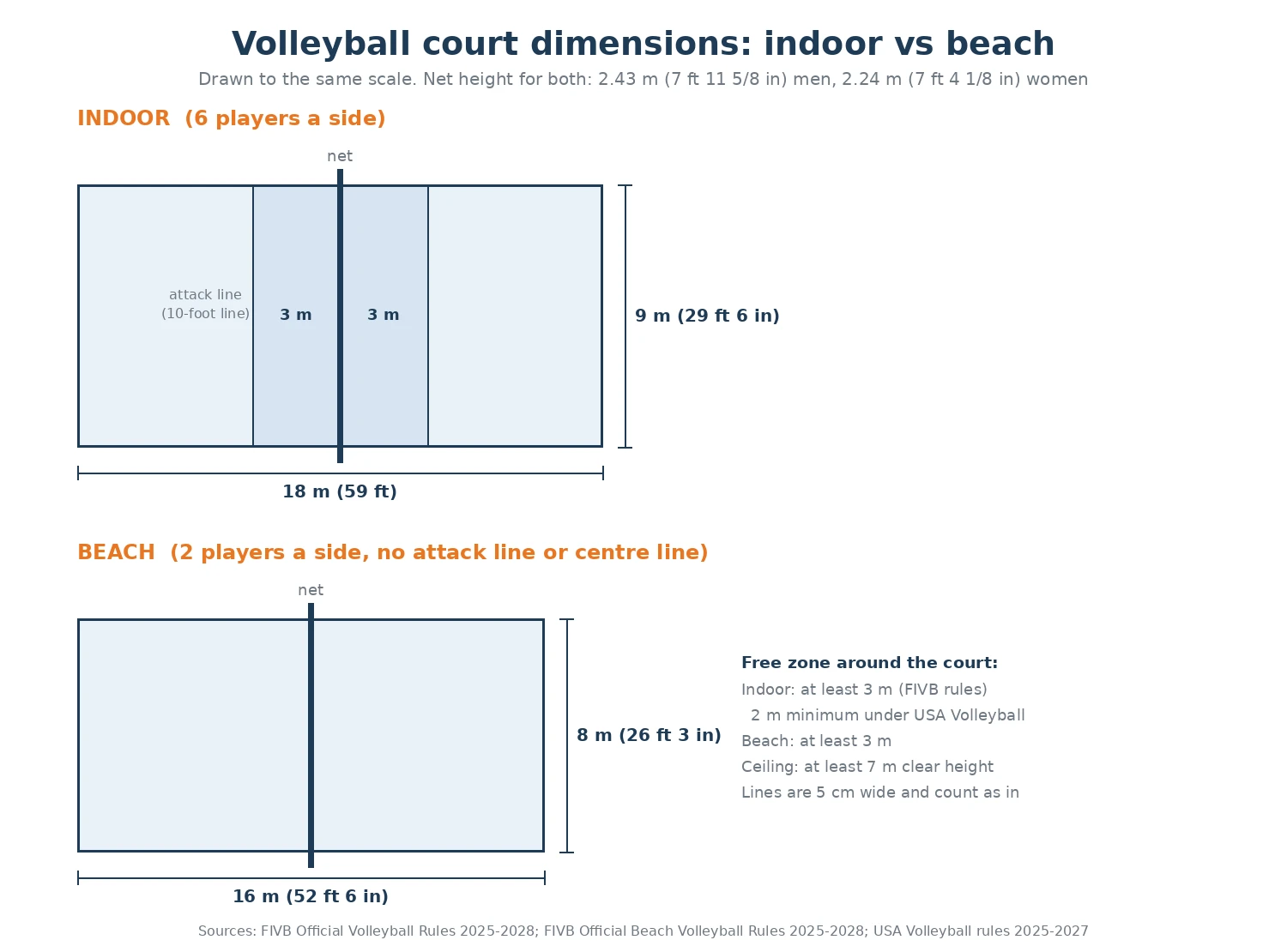
Indoor court dimensions
| Measurement | Metric | Imperial | Rule |
|---|---|---|---|
| Playing court | 18 × 9 m | 59 ft × 29 ft 6 in | FIVB 1.1 |
| Each half | 9 × 9 m | 29 ft 6 in square | FIVB 1.3.3 |
| Attack line (from centre line) | 3 m | 9 ft 10 in | FIVB 1.3.4 |
| Line width | 5 cm | 2 in | FIVB 1.3.1 |
| Free zone, minimum | 3 m on all sides | 9 ft 10 in | FIVB 1.1 |
| Free zone, FIVB world competitions | 5 m from sidelines, 6.5 m from end lines | 16 ft 5 in / 21 ft 4 in | FIVB 1.1 |
| Free zone, USA Volleyball minimum | 2 m | 6 ft 6 3/4 in | USAV 1.1 |
| Clear ceiling height, minimum | 7 m | 23 ft | FIVB 1.1 |
| Ceiling height, FIVB world competitions | 12.5 m | 41 ft | FIVB 1.1 |
Sources: FIVB Official Volleyball Rules 2025–2028 and USA Volleyball Indoor Rules 2025–2027.
Lines and zones
- Boundary lines. Two sidelines and two end lines mark the court. They’re part of the court, so a ball that touches a line is in.
- Centre line. Runs under the net and divides the court in half. A player’s foot may touch the opponent’s court only if part of it stays on or above the centre line.
- Attack line (the “10-foot line”). 3 m from the centre line, which is 9 ft 10 in, so the nickname is slightly generous. It separates the front zone from the back zone and limits back-row attacks.
- Front zone and back zone. The front zone is between the centre line and the attack line; the back zone is everything behind it.
- Service zone. The 9 m-wide area behind the end line, extending to the end of the free zone. The server can serve from anywhere in it.
Net and antennas
| Item | Specification |
|---|---|
| Net width (top to bottom) | 1 m (3 ft 3 in) |
| Net length | 9.5 to 10 m (31 ft 2 in to 32 ft 10 in) |
| Antennas | 1.8 m long, 10 mm thick, top 80 cm above the net |
| Where height is measured | At the centre of the court; both ends must be the same height and no more than 2 cm above the official height |
The antennas sit directly above the sidelines and mark the sides of the crossing space. A ball that touches an antenna or crosses outside it is out.
Net height by level
| Level | Women / girls | Men / boys |
|---|---|---|
| Adult, college (NCAA), international | 2.24 m (7 ft 4 1/8 in) | 2.43 m (7 ft 11 5/8 in) |
| US high school | 7 ft 4 1/8 in | 7 ft 11 5/8 in |
| USA Volleyball 15–18 & under | 7 ft 4 1/8 in | 7 ft 11 5/8 in |
| USA Volleyball 13–14 & under | 7 ft 4 1/8 in | 7 ft 4 1/8 in |
| USA Volleyball 11–12 & under | 7 ft 0 in | 7 ft 0 in |
| USA Volleyball 10 & under | 6 ft 6 in | 7 ft 0 in |
| USA Volleyball 45 & over | 7 ft 2 1/8 in | 7 ft 11 5/8 in |
| USA Volleyball 55 & over | 7 ft 2 1/8 in | 7 ft 9 5/8 in |
Youth and masters heights are from the USA Volleyball rulebook; leagues outside USA Volleyball may use different youth heights, so check your league’s rules. Middle school matches are usually played on the standard 18 × 9 m court with the net set by the state association or league.
Beach volleyball court dimensions
| Measurement | Metric | Imperial |
|---|---|---|
| Playing court | 16 × 8 m | 52 ft 6 in × 26 ft 3 in |
| Free zone, minimum | 3 m | 9 ft 10 in |
| Free zone, FIVB world competitions | 5–6 m | 16 ft 5 in – 19 ft 8 in |
| Net height | Same as indoor: 2.43 m men, 2.24 m women | 7 ft 11 5/8 in / 7 ft 4 1/8 in |
| Lines | 5 cm wide; no centre line, no attack line | 2 in |
Source: FIVB Official Beach Volleyball Rules 2025–2028. Beach volleyball is played two against two, which is why the court is smaller. See our volleyball rules guide for the other differences.
Grass, park and backyard courts
Grass and park leagues set their own sizes. Many use the beach size, 16 × 8 m, for doubles and the indoor size, 18 × 9 m, for sixes, but check your league. For a backyard court, add room around the lines: a full indoor-size court with a 3 m free zone needs about 24 × 15 m, and a beach-size court about 22 × 14 m. If you have less space, shrink the court and keep it twice as long as it is wide. Our outdoor volleyball nets guide covers net systems that set up on grass.
How to mark out a court with square corners
- Lay out one sideline at full length (18 m indoor, 16 m beach).
- Measure the width (9 m or 8 m) from each end, roughly at a right angle.
- Check the diagonals: for an 18 × 9 m court both should be 20.12 m (66 ft); for a 16 × 8 m court, 17.89 m (58 ft 8 in). Adjust the corners until the two diagonals match.
- Mark the centre line halfway along, then the attack lines 3 m either side for indoor play.
Frequently asked questions
How big is a volleyball court in feet?
An indoor court is 59 ft long and 29 ft 6 in wide. A beach court is 52 ft 6 in by 26 ft 3 in.
Is the 10-foot line actually 10 feet?
Not quite. It’s 3 m from the centre line, which is 9 ft 10 in.
How high is a volleyball net?
2.43 m (7 ft 11 5/8 in) for men and 2.24 m (7 ft 4 1/8 in) for women, indoors and on the beach. Youth nets are lower; see the table above.
Are beach and indoor volleyball courts the same size?
No. Indoor courts are 18 × 9 m; beach courts are 16 × 8 m. Net heights are the same.
What is the free zone?
The clear space around the court where players can still play the ball. It must be at least 3 m wide under FIVB rules; USA Volleyball allows a 2 m minimum.